
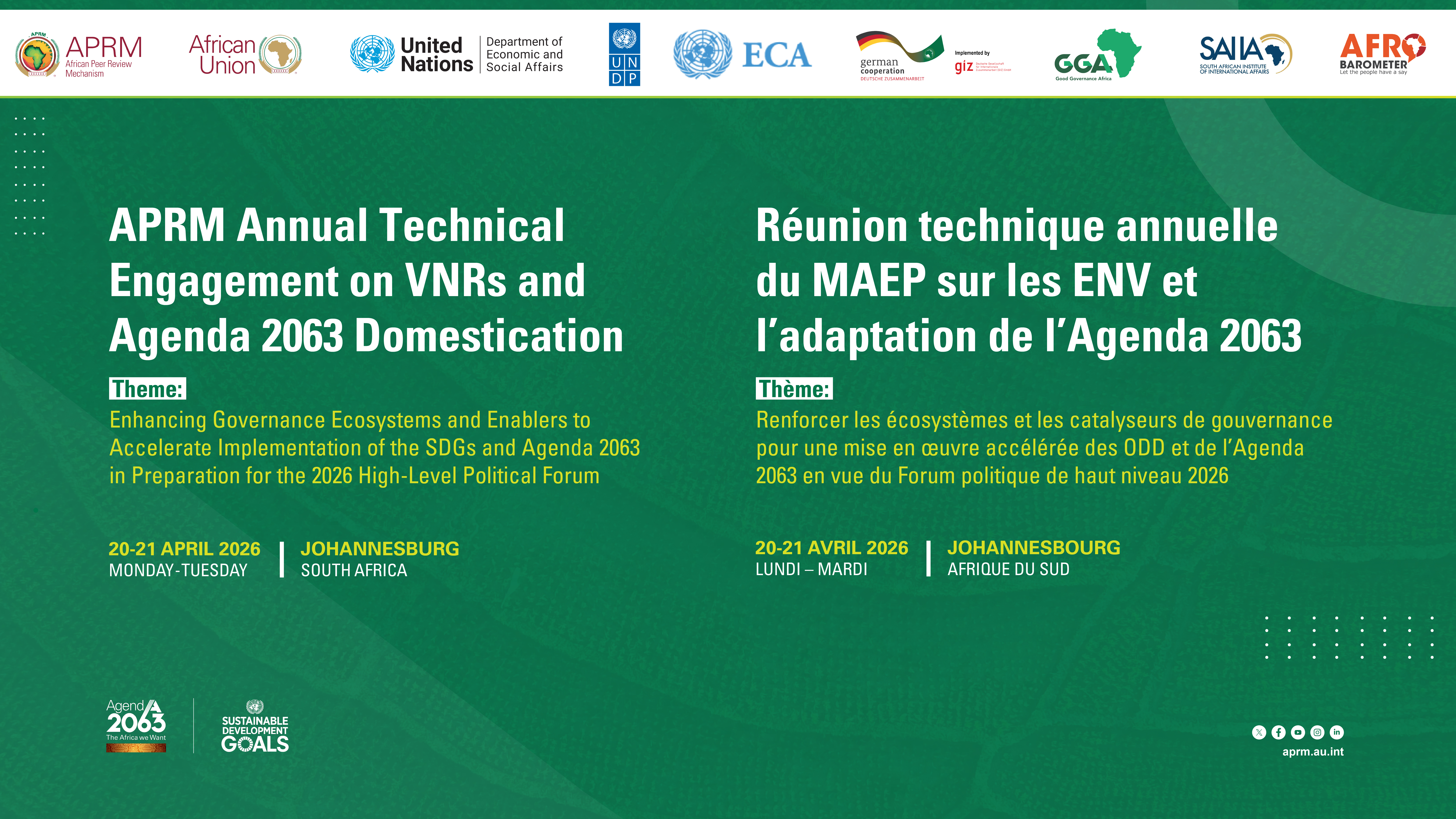
Annual Technical Engagement on VNRs and Domestication of Agenda 2063
Theme: Governance Eco-system and Enablers for Accelerated SDG and Agenda 2063, in preparations for the 2026 High-Level Political Forum
& In collaboration with AU organs, UN Agencies and Regional Economic Communities
Johannesburg
20-22 April 2026
Background and Context
- The African Peer Review Mechanism (APRM), in collaboration with strategic partners, is organising its annual High-Level Technical consultations for Agenda 2063 Peer-learning under the theme of “Capacity Building for African Countries on Governance Ecosystem and Enablers for Accelerated SDG and Agenda 2063” in preparations for the 2026 High-Level Political Forum”.
- This continental exercise is the tenth of its format since the foundation of the APRM Platform for VNRs and Agenda 2063 domestication in Africa in 2019 to build national competencies and continental coherence for domestication and implementation of SDGs and Agenda 2063 for a further integrated Africa.
- The APRM and UN agencies, particularly UNDP, UNOSSC, UNDESA, UNECA and UN Women, share a resilient record of collaboration that has strengthened the capacities of more than 700 policymakers[1]and other stakeholders in development planning, governance and institutional building as well as regional cooperation since 2019.
- These continental capacity-building programmes enhanced national capacities for reporting on the 2030 Agenda for Sustainable Development and the AU Agenda 2063. They also equipped national policymakers and relevant stakeholders with the necessary tools to improve the means of implementation of both agendas.
- This continental platform directly contributes to the operationalisation of the AU-UN Framework for the Implementation of Agenda 2063 and the 2030 Agenda for Sustainable Development, and the Pact for the Future, which recommends the implementation of both agendas through one framework and strengthens public institutions and peaceful societies.
- The significance of this continental exercise is critical, especially with the fact that nineteen African countries are expected to submit their voluntary national Reviews (VNRs) at the 2026 High-Level Political Forum. Further, the following inputs from various engagements underlined the need to continue providing technical support to African countries, particularly regarding institutional building and reporting on both agendas.
- the Fifth meeting of the African Union-United Nations High-Level Strategic Dialogue on Sustainable Development that was held on 10 November 2025, as well as the Ninth African Union-United Nations Annual Conference that was convened by the Secretary-General of the United Nations and the Chairperson of the African Union Commission on 12 November 2025, reaffirmed the AU-UN partnership as central to Africa’s transformation, setting a clear trajectory for coordinated results-orientated development efforts across the continent. Both meetings noted the need to ensure the effective integration of Agenda 2063 and the 2030 Agenda into national frameworks, and to address implementation gaps through strengthened institutional coherence, country-led implementation, data-driven decision-making, and financing.
- The APRM-UNOSAA High-Level Dialogue, hosted by the Government of Liberia on “APRM: Renewed Vision for Adaptive Governance and Sustainable Development in Africa” on the margins of UNGA, 25 September 2025, also noted the urgent need for a coherent approach to promote “ Anticipatory Governance” to enhance strategic coordination and mutual accountability, ensuring that UN support is aligned with the priorities of the African Union, particularly in the context of the Second Ten-Year Implementation Plan (STYIP 2024-2033) of Agenda 2063.
- The 2025 Kampala Declaration on Sustainable, Inclusive, Science-based and Evidence-based Solutions for Driving Job Creation and Economic Growth and for Implementing the 2030 Agenda and Agenda 206 called for urgent actions to address many challenges faced by African countries. Although Africa’s GDP is set to increase to 4.1% in 2026, the continent being home to several of the world’s fastest-growing economies, such as Côte d’Ivoire, Ethiopia, Rwanda, and Uganda, progress towards the SDGs is mostly off track in the region.
- Of the 169 SDG measurable targets, only 4 are currently on track, 70 are advancing too slowly, while 29 are regressing. Significant gaps and challenges in implementing the AU Agenda 2063 also persist. As a result, 476 million Africans live in poverty, including 149 million newly pushed into deprivation by climate and economic disruptions.
- Connecting to this, the APRM-OECD regional report on “Policy Coherence for Sustainable Development’ alluded to a lack of policy coherence incentives at national and regional levels. The pilot programme, which targeted Kenya, South Africa, Namibia and Ghana, noted various positive strides in the alignment of national development plans with continental and global development frameworks. In many cases, African countries are navigating overlapping agendas and limited capacity with fragmented institutions and uneven implementation. Multiple ministries and agencies with overlapping mandates and weak horizontal coordination create policy silos and conflicting decisions.
- Further, limited analytical capacity, lack of accurate, timely, disaggregated data, and weak monitoring systems hinder the identification of trade-offs and measuring spillovers. In some cases, the dual imperatives of the 2030 Agenda for Sustainable Development and the AU Agenda 2063: The Africa We Want, plus national development plans, complicate prioritisation and sequencing without strong inter-ministerial mechanisms. Countries are also dealing with implementation gaps, with well-designed policies often faltering due to resource limitations, bureaucracy, and weak accountability, leading to uneven outcomes across sectors and regions.
- To address alignment challenges across the 2030 Agenda and Agenda 2063, African countries need to mainstream SDGs and Agenda 2063 targets into coherent national development frameworks, with practical alignment requiring explicit mapping, sequencing and well-defined institutional roles. Successful alignment hinges on cross-government coordination units, stakeholder participation, and integrated planning budgets.
- There is also a need for embedding policy coherence and alignment in planning and budgeting, which will enhance the capacities of African countries to address the needs of populations and the multiple development challenges they face. Hence, African countries are urged to implement SDG target 17.14 – Enhance policy coherence for sustainable development – and the principles of Agenda 2063 to ensure that policy coherence at the continental and national levels is better domesticated at the sub-national level.
Objectives of the APRM Annual Technical Engagement
The objective of the technical engagement is to:
- Take stock of current progress on the SDGs and Agenda 2063 in Africa and APRM role in promoting both agendas through its reviews and governance support programme.
- Strengthen institutional frameworks for effective coordination and implementation of the second 10-year implementation of Agenda 2063 and the 2030 Agenda.
- Capacitate 17 African countries,[2] in promoting strategic planning, policy design, foresight, implementation, and monitoring and evaluation, ensuring that reforms are effective and sustainable.
- Generate evidence-based assessment of progress towards governance ecosystem and enablers of Agenda 2063 through the APRM continental tools.
- Promote multi-stakeholder engagement with civil society and academia to promote policy coherence in collaboration with the government interventions for sustainable communities.
- Build national capacities to leverage innovative tools to enhance policy coherence between the 2030 Agenda and Agenda 2063.
Expected Outcomes
By the end of this high-level technical engagement, participants will gain practical skills in how to:
- Standardise and enhance aligned reporting on VNRs and Agenda 2063 Moonshots while capitalising on the APRM governance thematic areas.
- Apply policy coherence tools and frameworks such as scorecards, dashboards and alignment matrices into national development frameworks.
- Encourage benchmarking between APRM member states on best practices for stronger governance structures and coherent policy for sustainable development at national and regional levels.
- Provide an evidence-based assessment of Governance Enablers for accelerating Agenda 2063 and SDGs for the STYIP.
- Develop country-specific action plans for improving coherence in national development strategies.
- Strengthen the whole-of-society approach and networks for peer learning and regional collaboration under the APRM National Planning Community of Practice.
- Synthesis of key recommendations from the African region for the HLPF 2026 and post 2030- Development framework.
Target Participants
Senior government officials from ministries of planning, finance and other sectoral ministries from 15 African countries will be invited to participate and will be joined by representatives from UN entities, experts from AU organs, representatives of national statistics offices and policy think tanks, civil society groups, youth representatives and other relevant stakeholders. Resident coordinators from all participating countries will be invited to join the workshop to align national priorities with UN Sustainable Development Cooperation Frameworks and the Second Ten-Year Implementation Plan of Agenda 2063 (STYIP).
Suggested materials
APRM Report: National Planning and Disaster Management in Africa
Outcome Report of APRM 4th NDP Community of Practice Meeting
OECD-APRM Report on Policy Coherence for Sustainable Development in Africa
UNDESA-APRM VNR Lab on Strategic Planning and Foresight – HLPF2025
Contacts
- Ms Sara Hamouda, Senior Continental Governance Officer, APRM Continental Secretariat, hamouda@aprm-au.org
- Mr Mohamed Koroma, APRM Liaison Officer to the African Union, APRM Continental Secretariat, Koroma@aprm-au.org.
- Bernadette Yiga, Agenda 2063/SDGs Research Assistant
Photos Link:
Photos - Annual Technical Engagement on VNRs and Domestication of Agenda 2063
Presentations Link:
Presentations - Annual Technical Engagement on VNRs and Domestication of Agenda 2063
Download PDF:
- ENG - Concept Note - Annual Technical Engagement on VNRs and Domestication of Agenda 2063
- FRE - Concept Note - Annual Technical Engagement on VNRs and Domestication of Agenda 2063
- ENG - Agenda - Annual Technical Engagement on VNRs and Domestication of Agenda 2063
- FRE - Agenda - Annual Technical Engagement on VNRs and Domestication of Agenda 2063