
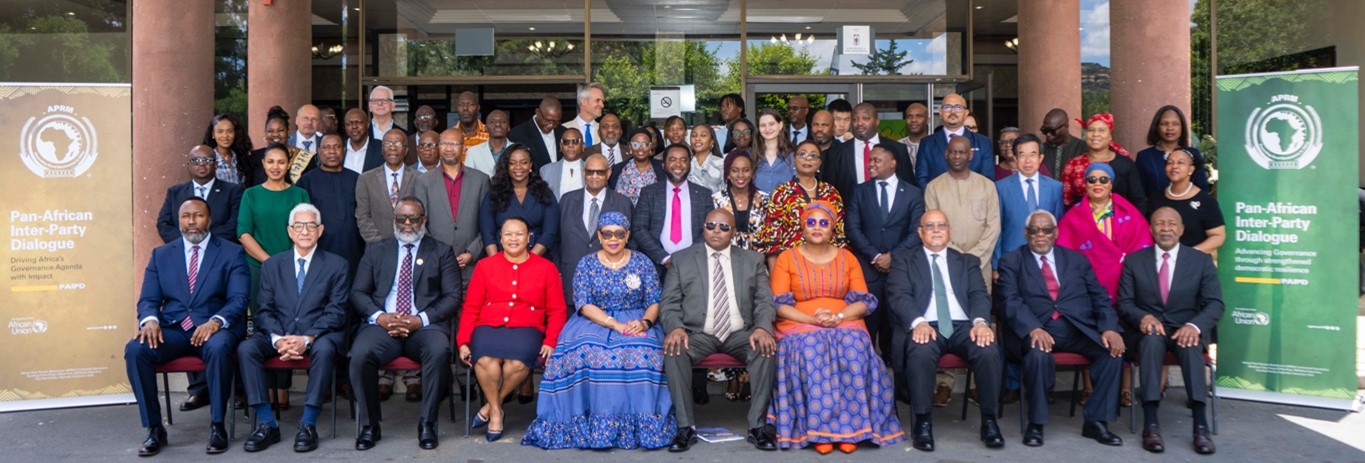
Maseru, Lesotho – 10–11 December 2025 – The African Peer Review Mechanism (APRM), in collaboration with the African Union Commission’s Department of Political Affairs, Peace and Security (PAPS), and key stakeholders, convened the first Pan-African Inter-Party Dialogue (PAIPD) Southern Africa Conference in Maseru, Kingdom of Lesotho. The conference brought together political parties represented in national parliaments across the Southern African Development Community (SADC), alongside governance institutions and experts, to advance democratic resilience as a foundation for early warning, conflict prevention, and sustainable governance.
Held under the theme : “Advancing Governance through Strengthening Democratic Resilience for Early Warning and Conflict Prevention,” the conference provided a neutral, non-partisan platform for ruling and opposition parties to engage constructively on shared political and economic governance challenges. The dialogue reflected a growing continental recognition that democratic stability, peace, and development depend on credible political institutions and effective governance systems.
Opening the conference, the Chief Executive Officer of the APRM Continental Secretariat, H.E. Amb. Marie-Antoinette Rose-Quatre, pointed out the central role of political parties as core institutions of democracy and governance. She emphasised that parties serve as the primary link between citizens and the state, shaping public policy, accountability, and democratic legitimacy, while highlighting the importance of preventive governance. In addition, she also called for a shift from reactive crisis management to approaches that embed resilience, inclusivity, institutional discipline, and public trust within democratic systems.
Delivering the keynote address on behalf of the Government of the Kingdom of Lesotho, H.E. Hon. Nthomeng Majara, Deputy Prime Minister and Acting Prime Minister, reaffirmed Lesotho’s commitment to democratic renewal, stability, and inclusive development. She expressed appreciation to the APRM for entrusting Lesotho to host the inaugural PAIPD Southern Africa Conference, describing it as a vote of confidence in the country’s reform trajectory following years of political instability. She noted that the conference marked an
important opportunity to consolidate peace, strengthen governance, and advance a democracy that delivers tangible benefits to citizens.
The Deputy Prime Minister highlighted key reforms underway, including the enactment of the 10th Constitutional Amendment in August 2025, aimed at strengthening institutions, reducing political instability, and anchoring governance in robust systems rather than individuals. She also outlined initiatives to address youth unemployment, combat transnational organised crime, and curb illicit political financing. Reaffirming Lesotho’s support for the APRM, she emphasised the importance of sustained investment in preventive governance, inter-party dialogue, and institutional reform in advancing Agenda 2063.
A major milestone of the conference was the launch of the APRM Targeted Review Report on Unconstitutional Changes of Government in the Kingdom of Lesotho. Presented by H.E. Ambassador Aly El-Hefny, Chairperson of the African Peer Review Panel of Eminent Persons and Lead Panel Member for Lesotho, the report focuses on addressing the structural and political drivers of instability through preventive, institution-centred reforms. It offers practical recommendations to strengthen constitutional order, electoral governance, and institutional capacity in support of long-term democratic consolidation.
Building on the report’s findings, a High-Level Panel Session on Early Warning and Conflict Prevention examined the impact of unconstitutional changes of government on peace, security, and sustainable development. The session was facilitated by Dr. McBride Nkhalamba, Acting Director for Governance and Specialised Reporting at the APRM Continental Secretariat, and it emphasised the responsibility of political parties in embedding early warning mechanisms and resilience within democratic systems.
Over the two days, participants engaged in high-level plenary sessions and thematic discussions on the evolving role of political parties in Africa’s governance architecture. Key issues included early warning and conflict prevention, youth and women’s political participation, institutionalising inter-party dialogue, and leveraging data and technology to strengthen intra-party democracy and citizen engagement. Discussions also explored the role of legislatures in promoting economic stability and policy credibility, including reflections on the African Credit Rating Agency (AfCRA).
In closing, participants underlined the need to better align national political processes with continental frameworks, including the African Charter on Democracy, Elections and Governance, Agenda 2063, and the APRM Strategic Plan 2025-2028. The conference concluded with a shared commitment to operationalising the Political Party Network, strengthening early warning capacities within party structures, advancing inclusive governance, particularly for women and youth, enhancing intra-party democracy and transparency, and promoting evidence-informed governance through the effective use of data and technology.
For media inquiries or further information, please contact: APRM Continental Secretariat at info@aprm-au.org.
@APRMorg – X
www.aprm.au.int